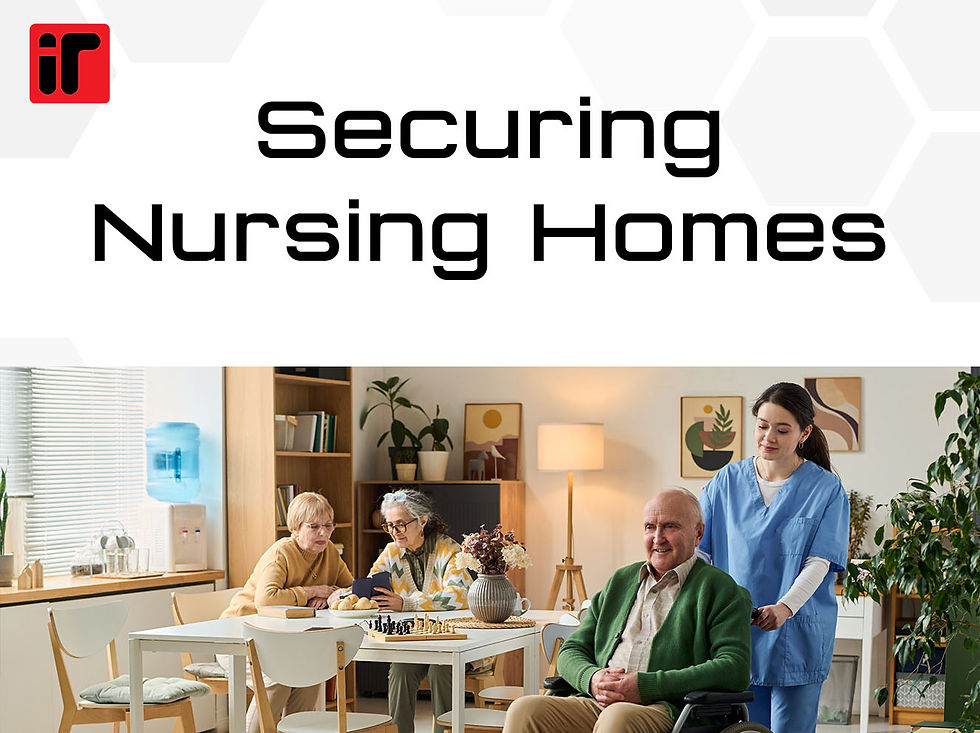
Healthcare Facility Security: Protecting Patients, Staff, and Critical Assets
Key Takeaway
A healthcare facility security system brings access control, video surveillance, intruder alarm and healthcare-specific integrations (Duress Systems, Nurse Call, RTLS, contractor management) into a single platform, enabling hospitals and medical centres to protect patients, staff, and critical assets while maintaining the open access essential to delivering care.
A healthcare facility security system is foundational to how modern hospitals and medical center's protect patients, staff, and the critical assets that enable care delivery. These environments operate 24/7 in high-pressure conditions where the need for open public access must be balanced against serious risks including unauthorized entry, workplace violence, and the protection of sensitive areas like pharmaceutical storage and medical equipment rooms.
The scale of the challenge is significant. Healthcare workers make up roughly 10% of the U.S. workforce but suffer 48% of all nonfatal workplace violence injuries (2018: US Bureau of Labour Statistics – Workplace Violence in Healthcare). Violence against healthcare staff costs U.S. hospitals an estimated $18.27 billion annually (2025 AHA Report), and 55% of healthcare workers reported an increase in physical assaults in the past year (US Security Magazine, BNP Media 2026).
These aren't just statistics. They represent a daily operational reality for facility managers, security teams, and clinical staff. The security system needs to address all of this while ensuring that patients, visitors, and emergency services can move through the facility without unnecessary friction.
Hospital Access Control for Complex Environments
Healthcare facilities are high-traffic, fast-paced environments with a diverse mix of stakeholders: patients, visitors, clinical staff, contractors, and emergency responders. Access control must be flexible enough to accommodate this complexity while maintaining strict protection of restricted areas.
Inner Range supports multiple authentication methods:
something you have (access cards, fobs, or mobile credentials),
something you know (PIN codes),
and something you are (biometric authentication such as fingerprint or facial recognition).
For high-security areas, a combination of these methods delivers the strongest level of access control.
Access to sensitive assets, such as medical equipment and pharmaceutical drugs, is closely monitored with detailed access reports offering complete visibility over who has gained entry and when. Time-based permissions ensure staff can only access restricted areas during periods where they have a valid reason to be there.
Duress Alarms and Staff Safety
Staff safety is one of the most pressing security concerns in healthcare. Duress alarms can be raised from fixed buttons (at reception desks, nursing stations, or patient rooms) or from wireless wearable transmitters carried by staff.
When triggered, these alarms generate immediate notification to first responders via push alerts, SMS, emails, or localized response systems. Precise location data is pinpointed on schematic maps, enabling a swift and coordinated response. If an alarm is not responded to within a pre-determined period, it can be escalated to a higher authority automatically.
This layered approach to duress response is increasingly important as new regulations (such as those from The Joint Commission) now hold hospitals accountable for protecting staff from foreseeable violence.
Integrated Video Surveillance for Healthcare
Video surveillance integration provides security control rooms with immediate access to live and recorded footage from multiple sites, monitored from a single location. Rich graphical maps and customizable camera layouts help security personnel respond quickly and effectively to unfolding events.
When linked to duress alarms and access events, video gives responders instant visual context. Rather than searching through hours of recordings, operators can immediately view footage associated with a specific incident, improving response times and accountability.
Healthcare-Specific Integrations
Healthcare facilities rely on a complex array of building and clinical subsystems that need to work together. Inner Range's platform integrates with healthcare-specific systems to create a truly unified solution.
Nurse Call and Paging system integrations enhance the flow of critical information, ensuring that healthcare professionals can communicate in real time during emergencies. Real-Time Location Systems (RTLS) display the live location and status of security personnel and assets on graphical maps, improving response times and compliance with workplace safety regulations.
The platform aggregates data from all connected systems, providing comprehensive analysis and pattern recognition that helps facility managers make data-driven decisions about security operations, staffing, and risk management.
Contractor and Visitor Access Management
Large healthcare facilities require the services of hundreds of independent contractors, each needing access to the premises. Inner Range integrates with dedicated Contractor Management Systems to ensure contractors are provided temporary access credentials and have complied with onsite health and safety inductions. Contractor time on site is accurately reconciled for auditing purposes.
Scalable Across Single and Multi-Site Healthcare Networks
Inner Range's solution is modular and highly customizable, allowing it to scale effortlessly. Whether managing a single medical center or a vast network of facilities with tens of thousands of access points, security inputs, and cameras, the platform grows with the organization. With over 130 native integrations and over 300+ 3rd party integrations, the system connects into existing infrastructure and adapts as the healthcare network expands.
Compliance with workplace health and safety regulations is built into the platform, with the ability to monitor patient activity or non-activity, facilitating a safe environment for both patients and staff.
Frequently Asked Questions
What are the biggest security challenges in healthcare facilities?
Healthcare facilities face a unique combination of challenges: the need for open public access balanced against unauthorized entry risks, high rates of workplace violence against staff, protection of pharmaceuticals and medical equipment, and managing access for a complex mix of patients, visitors, clinical staff, and contractors, all while maintaining compliance with health and safety regulations.
What type of access control is best for a hospital?
The most effective hospital access control combines multiple authentication methods (cards, fobs, mobile credentials, PINs, and biometrics) with time-based permissions and zone-specific policies. High-security areas such as pharmaceutical storage and medical equipment rooms benefit from multi-factor authentication, while public areas require a lighter approach that doesn't impede patient flow.
How do duress alarms work in a healthcare setting?
Duress alarms can be triggered from fixed buttons (at reception desks, nursing stations, or patient rooms) or from wireless wearable devices carried by staff. When activated, the system sends immediate alerts to first responders with precise location data pinpointed on schematic maps. If the alarm is not acknowledged within a set period, it is automatically escalated to a higher authority.
What healthcare-specific systems does Inner Range integrate with?
Inner Range integrates with Nurse Call and Paging systems, Real-Time Location Systems (RTLS), Contractor Management Systems, Visitor Management platforms, elevator management, lighting control, intercoms, and building automation systems, creating a unified security and building management solution from a single interface.
How does video surveillance support healthcare security?
Integrated video surveillance links camera footage directly to access events and duress alarms. When an incident occurs, operators can instantly view the associated footage without manually searching recordings. AI-powered analytics can also detect unusual activity in sensitive zones, sending alerts to monitoring center's for verification.
Ready to see how it works?